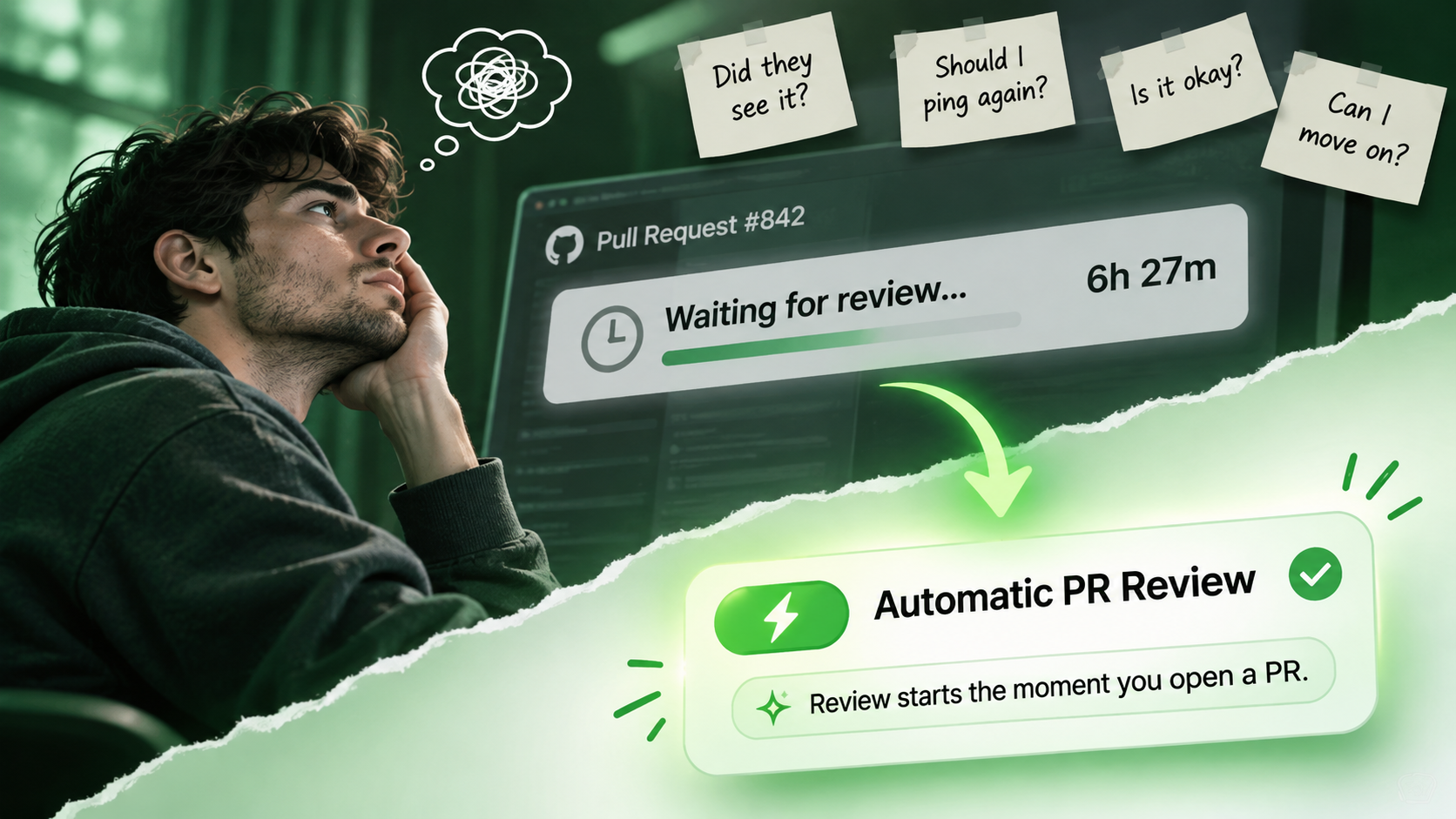
A practical guide to tracing dependencies, understanding code changes, and finding bugs that span multiple files.
What if the code you changed is correct but the code that depends on it is not?
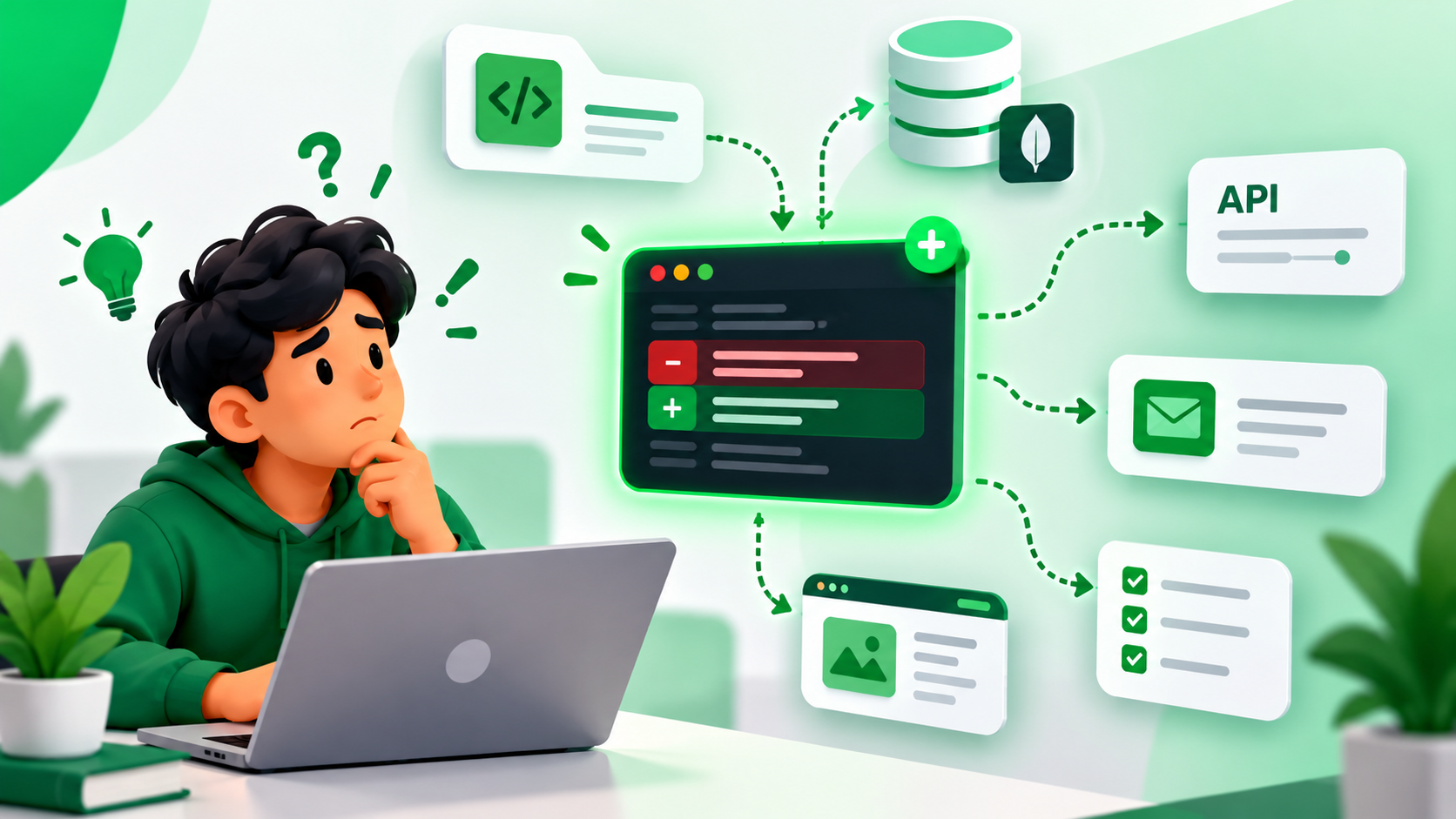
This is a common challenge in modern software development. Applications are made up of interconnected modules, services, APIs, and data flows. A change that looks harmless in one file can affect behavior across the entire system.
To review code effectively, we need to understand more than the diff. We need to understand the context surrounding it.
Why reviewing changed lines isn't always enough
A typical code review starts with a diff: the lines added, removed, or modified in a pull request.
Diffs are useful because they focus attention on the change. However, they don't automatically explain every dependency affected by it.
Consider a checkout process:
- A controller receives a checkout request.
- A payment service processes the payment.
- An order service updates the order status.
- A notification service sends the customer a confirmation email.
These operations may live in separate files or modules, but together they determine whether checkout behaves correctly.
If a payment service changes its output format, the controller may continue using the old format. That mismatch can cause a bug even when the modified service works as intended.
This is where cross-file and repository-level code reasoning become valuable.
A real-world-style example: The truthy object bug
Let's look at a simplified JavaScript example.
Initially, a payment function returns a boolean:
function processPayment() {
  // Payment processing logic
  return false;
}
A controller checks the result:
const result = processPayment();

if (result) {
  await confirmOrder();
}
The controller expects true to mean payment succeeded and false to mean it failed.
Now the service is updated to return a descriptive object:
function processPayment() {
  // Payment processing logic
  return {
    success: false,
    message: "Payment declined"
  };
}
But the controller remains unchanged.
In JavaScript, a non-null object is truthy. The condition if (result) therefore passes even though result.success is false.
The order could be confirmed after a declined payment.
The service's return contract changed, but its caller did not adapt to the change.
A safer controller would explicitly inspect the success property:
const result = processPayment();

if (result.success) {
  await confirmOrder();
}
In production code, you would also want appropriate error handling and tests around the payment flow.
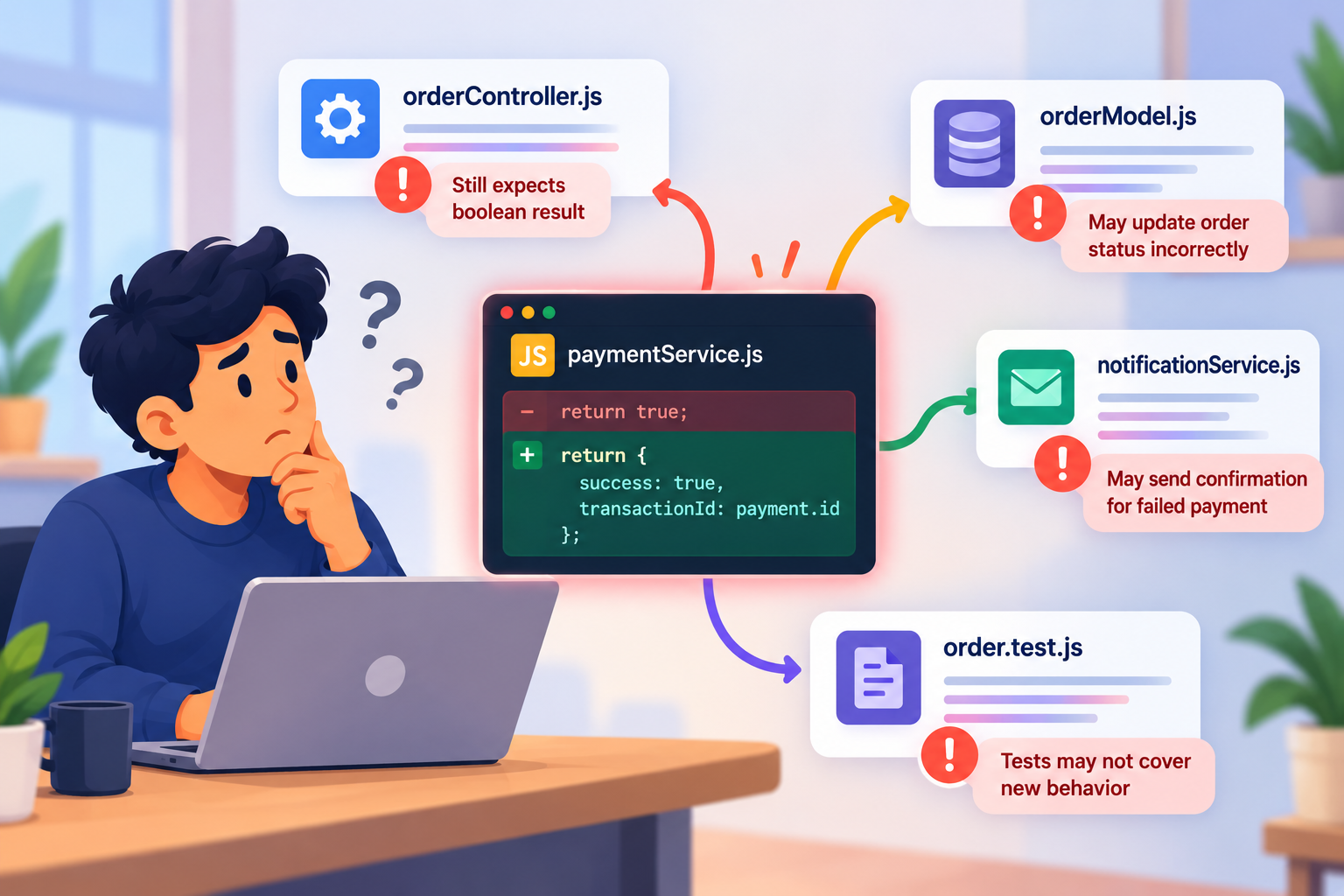
The key lesson is that correctness depends not only on what a function does, but also on how other parts of the application interpret its behavior.
What is cross-file code reasoning?
Cross-file code reasoning is the process of understanding how a code change interacts with related code in other files.
It involves tracing dependencies and checking whether assumptions remain valid after a change.
Useful questions include:
- Where is the modified function called?
- What input and output contracts do callers expect?
- Which operations depend on its result?
- Could the change affect error handling or state transitions?
- Which tests should change or be added?
For example, changing a payment service's return type should prompt a review of its callers, order-confirmation logic, and relevant tests—not just the payment service itself.
What makes repository-level reasoning different?
Repository-level reasoning broadens the investigation from individual connections to the overall structure of the codebase.
Depending on the change, this may involve examining:
| Area | What to investigate |
|---|---|
| Function callers | Whether every caller handles the new behavior |
| Shared interfaces | Whether types and contracts remain consistent |
| Data flow | Whether values are interpreted correctly downstream |
| Business logic | Whether important rules still hold |
| Database operations | Whether state changes occur under the right conditions |
| Error handling | Whether failures remain failures throughout the flow |
| Tests | Whether affected behavior is covered by meaningful checks |
The scope should be proportional to the change. A small formatting update doesn't need a repository-wide investigation. A change to authentication, payment handling, or a shared interface may deserve a much broader review.
The objective is not to read every file. It is to identify and validate the dependencies that matter.
A practical workflow for reviewing cross-file changes
1. Start with the intended behavior
Understand why the change exists. Identify the expected behavior and the conditions that should remain true after the change.
2. Check the contract
Look for changes to function signatures, return values, API responses, shared types, and error behavior.
A contract change can affect multiple consumers even when the implementation itself is correct.
3. Trace dependencies
Find the callers of the modified function and examine the next steps in the execution flow.
For a payment-related change, follow the result through order confirmation and any dependent notifications or database updates.
4. Check failure paths
Happy-path tests are not enough for many critical operations.
Ask what happens when a payment is declined, a request times out, a database update fails, or an external service returns an unexpected response.
5. Validate with tests
Write or update tests that reflect the expected behavior. In the example above, verify that a failed payment cannot trigger order confirmation.
When practical, run the relevant test suite and reproduce suspected failures.
6. Separate evidence from assumptions
A dependency may look risky without actually producing a bug. Confirm findings through code inspection, tests, or reproducible behavior before treating them as defects.
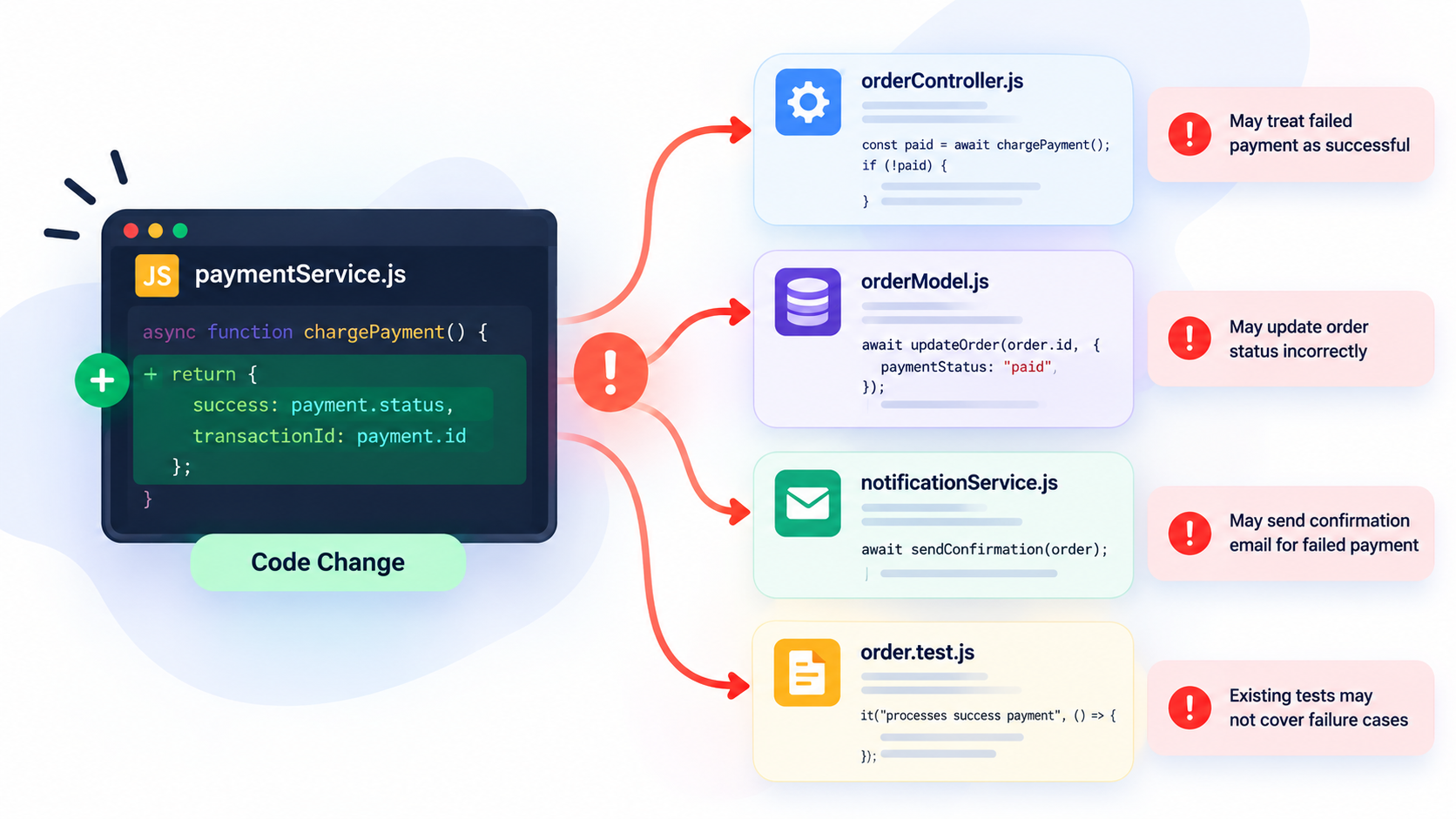
How AI can support repository-level reasoning
AI-assisted code analysis can help reviewers navigate unfamiliar code, trace dependencies, summarize how modules interact, and identify areas that may need additional testing.
This can reduce the effort required to understand a large change, especially when its effects extend beyond the files shown in a pull request.
However, AI analysis has limitations. It can miss implicit runtime behavior, misunderstand an interface, or produce a plausible but incorrect finding.
Use it as an aid to investigation, not as proof that a change is safe. Human review, automated tests, and knowledge of the system's requirements remain essential.
Final thoughts
A code diff tells you what changed. Repository-level reasoning helps you understand what that change means for the rest of the application.
By tracing dependencies, checking contracts, following data flows, and validating failure paths, developers can catch issues that are easy to miss when reviewing files in isolation.
The next time you review a pull request, ask yourself:
If this behavior changes here, which other parts of the system depend on it?
About the author
- Codzee is building the future of AI-powered code reviews for modern engineering teams. We help developers review pull requests faster, improve code quality, and ship software with confidence. Codzee analyzes your code, highlights potential issues, suggests meaningful improvements, and delivers actionable feedback that fits your team's coding standards and workflow. Our mission is simple: make code reviews faster, smarter, and more collaborative without disrupting how developers work. Whether you're a startup shipping your first product or a growing engineering organization, Codzee helps reduce review bottlenecks, maintain consistent code quality, and improve developer productivity. At Codzee, we believe AI should support developers, not replace them. That's why we're building AI Code Review That Respects Your Team.
Comments
Join the discussionNo comments yet. Be the first to comment.