Software engineering is becoming increasingly AI-assisted.
Code can be generated faster. Tests can be written faster. Refactors can be proposed faster. Documentation can be produced faster.
But there is a problem hiding underneath that productivity gain:
Can engineering teams understand and control the risks created by all that additional change?
This is where the idea of Engineering Intelligence becomes useful.
Engineering Intelligence is not simply AI code review.
It is the ability to continuously understand what is changing, where engineering risk is accumulating, who needs to review it, how quickly changes are being validated, and which problems keep recurring across a team or codebase.
A useful mental model is:
                 AI-assisted development
                         │
                         ▼
                 More code + more PRs
                         │
        ┌────────────────┼────────────────┐
        ▼                ▼                ▼
   Review workload   Engineering risk   Change velocity
        │                │                │
        └────────────────┼────────────────┘
                         ▼
                Engineering Intelligence
                         │
        ┌────────────────┼────────────────┐
        ▼                ▼                ▼
     Better review   Risk visibility   Better decisions
The goal isn't simply to review more code.
It is to make engineering decisions with better information.
1. PR Review Is Only One Part of the Problem
Traditional code review largely answers:
“Does this change look correct?”
That's important, but incomplete.
An engineering organization also needs to understand:
Which types of changes create the most risk?
Which services generate recurring problems?
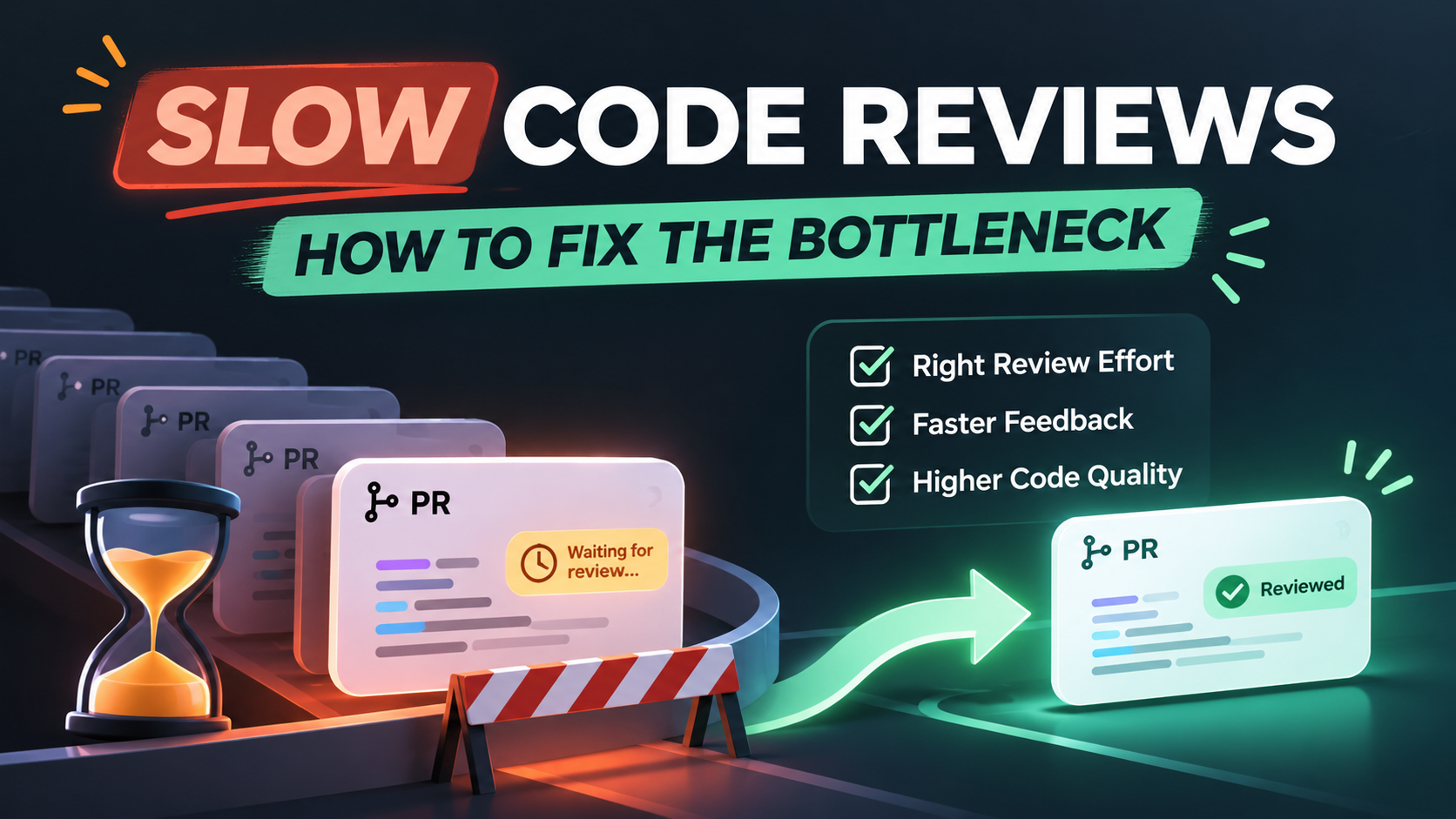
Which reviewers are overloaded?
Where are reviews taking too long?
Which findings repeatedly appear across PRs?
Are AI-assisted changes increasing review volume?
Which teams are accumulating technical risk?
Imagine two teams.
Team A
100 PRs
↓
Average review time: 3 hours
↓
5 recurring security issues
↓
High review rework
Team B
100 PRs
↓
Average review time: 45 minutes
↓
Few recurring issues
↓
Predictable review process
Both teams shipped the same number of PRs.
Their engineering health is clearly not identical.
PR count alone doesn't explain that difference.
2. Engineering Risk Needs Context
Not every code change carries the same risk.
Changing a UI label is different from changing:
Authentication
    ↓
Authorization
    ↓
Payment processing
    ↓
Database migration
    ↓
Production infrastructure
A useful risk model can consider multiple dimensions:
Engineering Risk
      │
      ├── Change complexity
      ├── Security sensitivity
      ├── Business criticality
      ├── Dependency impact
      ├── Historical defects
      ├── Test coverage
      └── Reviewer expertise
For example, changing ten lines inside an authentication middleware may deserve more scrutiny than changing 300 lines of generated documentation.
Line count is therefore a poor standalone measure of engineering risk.
3. Reviewer Workload Is an Engineering Signal
Code review is often treated as an invisible activity.
But reviewers have limited attention.
Suppose an engineer receives:
Monday
├── PR #101
├── PR #102
├── PR #103
├── PR #104
└── PR #105

Tuesday
├── PR #106
├── PR #107
└── PR #108
Now imagine several of those PRs contain large AI-generated changes.
The problem isn't simply the number of PRs.
It's the amount of cognitive work required to understand them.
Review workload can be viewed as:
Review Load =
PR volume
×
Change complexity
×
Context required
×
Risk
This explains why adding more engineers doesn't always solve review bottlenecks.
The bottleneck may be specialized knowledge.
For example:
Payment service
       ↓
Requires payment-domain expertise
       ↓
Only 2 engineers can confidently review
       ↓
Both become overloaded
       ↓
Review latency increases
Engineering Intelligence should make that bottleneck visible.
4. AI-Assisted Code Changes the Review Equation
AI-assisted development changes how code is produced.
A developer might previously spend half a day implementing a feature.
With AI assistance, the implementation could take substantially less time.
But the reviewer still needs to understand:
What changed?
Why did it change?
What assumptions were made?
What happens on failure?
What happens under concurrency?
Does it fit the architecture?
This creates an asymmetry:
Code generation
      ↓
      Faster
      ↓
More changes
      ↓
More review demand
      ↓
Human attention becomes the bottleneck
AI therefore doesn't eliminate the need for review.
It can make review quality and review capacity more important.
5. Review Latency Is More Than a Delivery Metric
Consider:
PR opened
   ↓
Waiting for reviewer
   ↓
Review starts
   ↓
Changes requested
   ↓
Developer responds
   ↓
Second review
   ↓
Merge
If this process takes two days, the delay isn't necessarily caused by coding.
It may be caused by organizational bottlenecks.
Review latency can reveal:
Reviewer overload
Poor ownership boundaries
Large PRs
Missing domain expertise
Unclear requirements
Excessive review iteration
A team should therefore distinguish:
Coding time
from
Validation time.
High development velocity with slow validation can still produce a slow delivery system.
6. Recurring Risks Matter More Than Individual Findings
Imagine an organization discovers the same issue repeatedly:
Week 1 → Missing authorization check
Week 2 → Missing authorization check
Week 4 → Missing authorization check
Week 6 → Missing authorization check
Treating these as four unrelated PR comments misses the larger engineering problem.
The important question becomes:
Why does this risk keep appearing?
Possible causes include:
Missing abstractions
Weak documentation
Inadequate tests
Poor framework defaults
Training gaps
Architectural design problems
This is where Engineering Intelligence moves beyond code review.
A review system identifies a problem.
An intelligence system should help identify the pattern behind the problems.
7. From Review Data to Engineering Health
Engineering teams already generate enormous amounts of information:
Git commits
PRs
Reviews
CI results
Deployments
Incidents
Security findings
Reverts
Test failures
Individually, these signals are useful.
Together, they can reveal engineering health.
For example:
Increasing PR size
        +
Increasing review latency
        +
Increasing reviewer workload
        +
Repeated production regressions
        ↓
Potential engineering bottleneck
This doesn't mean every increase indicates a problem.
Context matters.
But trends can tell engineering leaders where to investigate.
8. A Practical Engineering Intelligence Framework
A useful framework has five layers.
Layer 1 — Observe
Collect engineering signals.
PRs
Reviews
Commits
CI
Deployments
Incidents
Layer 2 — Understand
Classify changes.
Security
Performance
Architecture
Reliability
Business logic
Maintainability
Layer 3 — Connect
Connect changes to people, systems and history.
PR
 ↓
Service
 ↓
Past incidents
 ↓
Recurring risks
 ↓
Relevant reviewers
Layer 4 — Prioritize
Not every signal deserves equal attention.
High risk
    ↓
Immediate attention

Medium risk
    ↓
Normal review

Low signal
    ↓
Avoid unnecessary noise
Layer 5 — Learn
Feed outcomes back into engineering processes.
Finding
   ↓
Review decision
   ↓
Was it real?
   ↓
Was it fixed?
   ↓
Did the problem recur?
   ↓
Update engineering knowledge
This final layer is critical.
Without learning, engineering intelligence becomes another dashboard.
9. What Engineering Intelligence Should Ultimately Answer
For developers:
“What should I pay attention to in this change?”
For engineering leads:
“Where is my team accumulating risk or review bottlenecks?”
For CTOs:
“Is engineering velocity increasing without sacrificing reliability and maintainability?”
Those are different questions.
A useful Engineering Intelligence system connects them.
Developer
   │
   ▼
Change-level intelligence
   │
   ▼
Team-level intelligence
   │
   ▼
Organization-level intelligence
Conclusion
AI-native engineering isn't simply traditional software development with an AI coding assistant attached.
The economics of producing software are changing.
When code becomes cheaper and faster to generate, engineering attention becomes relatively more valuable.
That makes review quality, risk visibility, reviewer workload, recurring failure patterns, and validation latency increasingly important.
Engineering Intelligence is therefore best understood as a feedback loop:
Build
 ↓
Review
 ↓
Measure
 ↓
Learn
 ↓
Improve
 ↓
Build again
The goal isn't to replace engineers with automation.
It's to give engineers better visibility into the systems they're changing—and help teams spend their limited attention on the changes that matter most.
About the author
- Codzee is building the future of AI-powered code reviews for modern engineering teams. We help developers review pull requests faster, improve code quality, and ship software with confidence. Codzee analyzes your code, highlights potential issues, suggests meaningful improvements, and delivers actionable feedback that fits your team's coding standards and workflow. Our mission is simple: make code reviews faster, smarter, and more collaborative without disrupting how developers work. Whether you're a startup shipping your first product or a growing engineering organization, Codzee helps reduce review bottlenecks, maintain consistent code quality, and improve developer productivity. At Codzee, we believe AI should support developers, not replace them. That's why we're building AI Code Review That Respects Your Team.
Comments
Join the discussionNo comments yet. Be the first to comment.